

Understanding Anatomy and Biomechanics | Insight into Structure, Movement, and Workload Capacity
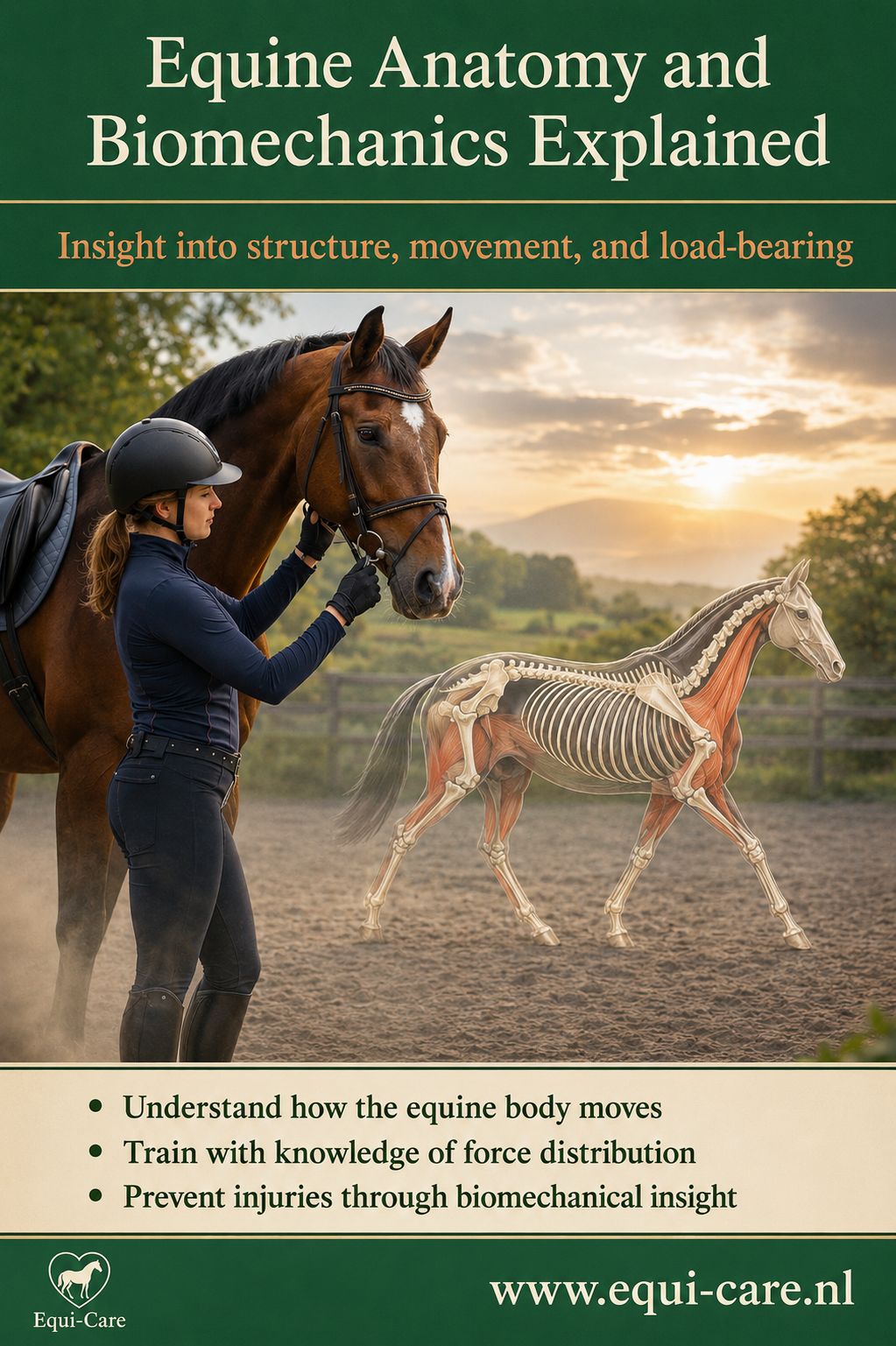
A horse moves with power, suppleness, and refined coordination. Yet, that movement is no coincidence. Behind every stride, transition, or jump lies a complex interplay of bones, joints, muscles, tendons, and nerves. In this comprehensive digital guide by Equi-Care, you will discover how the horse's body truly functions and why a knowledge of anatomy and biomechanics is essential for responsible training and sustainable equine welfare.
This guide helps you look at movement through different eyes—focusing not only on what a horse does, but primarily on why it does it. This is because many problems in posture, performance, or behavior have a physical origin. A horse that struggles with canter, collection, or balance is often displaying important signals through its body.
By gaining insight into conformation, force distribution, and movement mechanics, you will learn to observe with greater purpose, train more fairly, and recognize overloading sooner. Throughout this journey, welfare always remains central: biomechanical understanding is not about demanding more from the horse, but about better understanding what the body can realistically handle.
"Understanding the body is the foundation of respectful training." This forms an important core theme throughout this guide.
What you will learn in this guide
In this comprehensive Equi-Care guide, you will discover how the horse's skeleton is structured and what role bones, joints, and vertebrae play in movement and workload capacity. You will learn how the forehand and hindquarters function differently biomechanically, and why correct joint loading is essential for longevity.
In addition, you will receive extensive explanations regarding muscles, tendons, and ligaments. The guide demonstrates how muscle chains work together, how force is transmitted through tendons, and why stability and coordination are indispensable for healthy movement.
The vertebral column and the importance of correct back usage are also discussed in depth. You will discover how the back functions as a connecting axis between the forehand and hindquarters, and how training, rider weight, and saddle fit influence freedom of movement and carrying power.
Furthermore, you will learn how the walk, trot, and canter differ from one another biomechanically. The guide analyzes force distribution, moments of suspension, shock absorption, and the importance of correct hindquarter activity within each individual gait.
Additionally, this guide contains detailed explanations of bending, balance, and collection. You will discover what happens anatomically during lateral movements, how the center of gravity shifts, and why true collection arises from carrying power instead of just a forced posture.
Workload, injury prevention, and recovery also receive considerable attention. You will learn how adaptation works, why overloading often develops gradually, and how recovery forms an active component of responsible training.
Moreover, you will discover how anatomical knowledge becomes practically applicable in daily training and care—ranging from the observation of asymmetry and movement quality to hoof care, saddle fitting, training progression, and stable management.
The guide also looks extensively at individual differences between horses. Not every horse is biomechanically built for the same workload or discipline, which is precisely why training requires customization and respect for anatomical boundaries.
The relationship between welfare and biomechanics runs as a common thread through the guide as well. You will learn why resistance, tension, or a loss of performance often have physical causes rather than being signs of "disobedience."
Finally, this guide helps you view anatomy and biomechanics not as dry theory, but as a practical foundation for a sustainable partnership between human and horse.
Who is this guide for?
This guide is interesting for people who want to better understand: Equine anatomy, equine biomechanics, the horse's body, equine movement, back usage in horses, collection in horses, balance in horses, muscle building in horses, injury prevention in horses, horse training, force distribution in horses, equine tendons and ligaments, correct workload loading, and sustainable equine welfare.
What you can expect
- Practical and in-depth explanations in the signature Equi-Care style
- Heavy focus on biomechanics, training, and welfare
- Insight into structure, movement, and workload capacity
- Practical tools for observation and training
- Clear explanations regarding muscles, joints, and back usage
- Focus on sustainable development and injury prevention
Related topics
Pairs well with:
- The 10 Building Blocks
- Hoof Balance and Your Horse's Body
- The Missing Link in Training
- Rider Biomechanics
Exclusively available digitally via Equi-Care
You will receive a download link immediately after purchase.
Digital products cannot be returned or canceled.


